Handing your child scissors can make it feel as though they should immediately cut a straight line or finish a project. The first goal is not neat cutting. Holding scissors safely, placing paper between the open blades, and closing them once is enough.
Key point
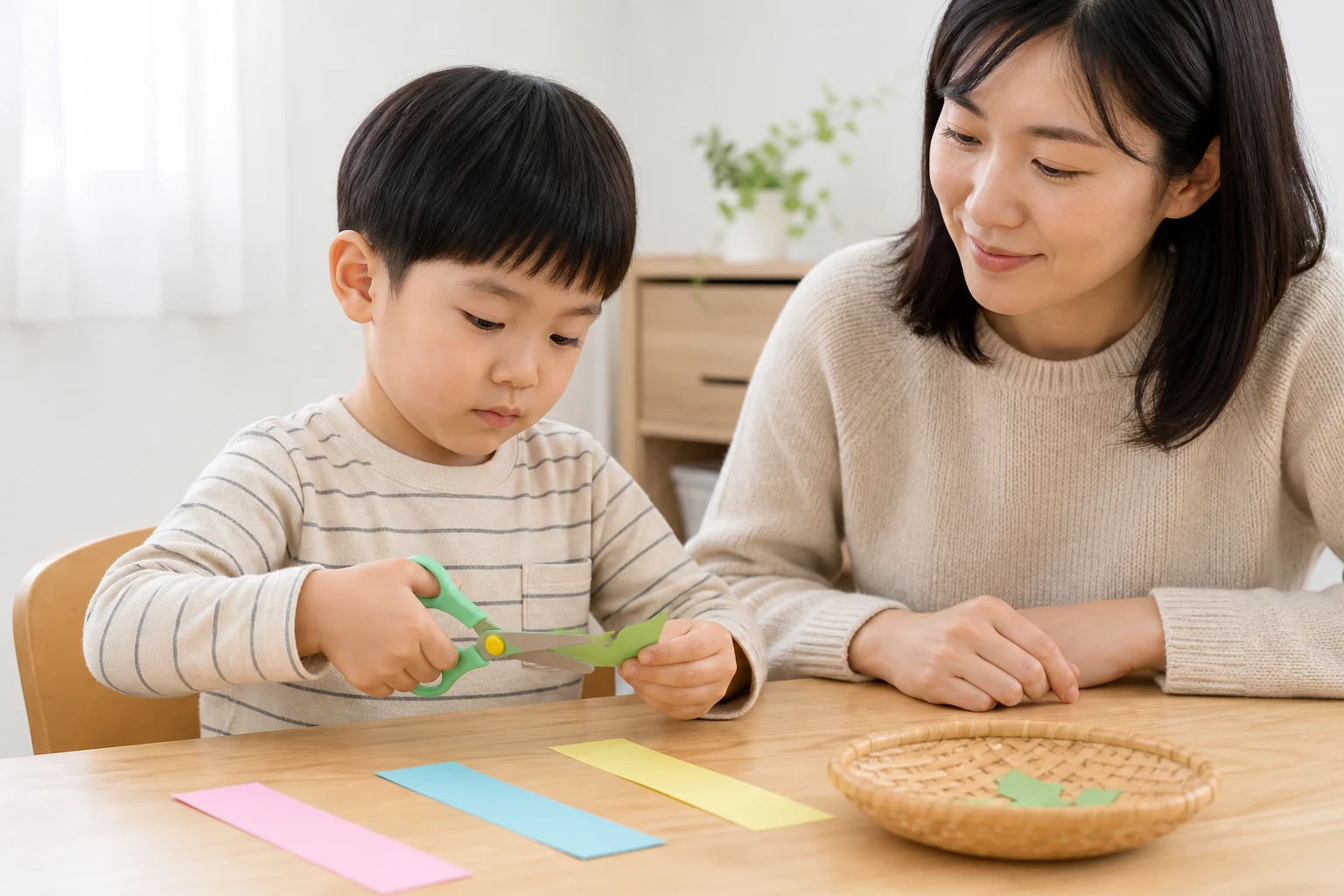
Prepare round-tipped safety scissors and short, wide paper strips. Offer one snip, cutting a short strip, and free cutting and pasting as optional play, not required stages.
What to remember
- Start by sitting face-to-face with an adult and trying just one snip.
- Practice the rules together: sit to cut, cut only paper, and put scissors down before moving.
- Discuss pain, ongoing difficulty with one hand, or loss of earlier skills at a medical visit or consultation.
Look at readiness now, not a starting age
Preschoolers can have chances to explore safety scissors and paper, but there is no passing standard for what to cut at a certain age. Notice whether your child wants to explore scissors, can listen to brief guidance while seated, and tries to hold paper in one hand while moving a tool with the other. Cutting off the line or changing finger placement is natural in early attempts.
Preschool hand and finger activities include drawing, building, and dressing. Cutting is just one option, not a task to pass. Instead of linking scissors to guaranteed handwriting or concentration gains, keep it as one paper activity your child can enjoy now.
Keep the first materials small and simple
Prepare round-tipped children's safety scissors and short, wide paper strips. Sit close, show the blades pointing away from people, and put paper between them. Name one movement at a time: "Open, put it in, and close." Instead of gripping and moving your child's hand, lightly help only with holding the paper if needed, leaving room for your child to close the scissors.
At first, one snip off the end of a strip and a small piece falling away is enough. The pieces can go in a basket or be glued onto a large sheet. Your child can also stop if they do not want more. Long straight lines, curves, and complex patterns are possible later materials, not required steps.
Practice safety rules before cutting
Use scissors seated and only on paper. Do not carry them while walking or running. To pass them to a friend, give them to an adult first or offer the handles. Specifically repeat that hair, clothes, cords, skin, and electrical wires are not paper. After use, return scissors and paper to an adult, who stores them.
Choose tools for your child's age and ability, and have an adult watch nearby throughout use. Do not increase difficulty with regular adult scissors, cracked or dull scissors, or unsupervised cutting. If your child gets excited or tries to leave the seat, stop and put the scissors away.
Choose one of three paper activities
Set out three sheets: the first for one snip, the second for several cuts in short paper, and the third for choosing and pasting cut pieces. Your child can choose only one today or repeat the same activity.
Do not make a left-handed child switch to the right hand. Explore whether the scissors suit their preferred hand and which way to turn the paper to make it easier. Describe the action, such as "The paper dropped off," or "You want to stop here," rather than the finished product. This helps your child decide whether to try again.
Some observations call for a consultation
Difficulty on the first try does not mean a problem. But if your child often reports hand or arm pain, uses one hand much less, has persistent trouble with several everyday hand tasks such as buttons and spoons as well as scissors, or loses a previously used skill, do not simply have them repeat the game more. Write down what you observed and discuss it with a pediatrician or relevant service.
Developmental milestones are a starting point for caregivers and clinicians to look at overall development together, not a test that judges a child. Share everyday hand use, discomfort, and whether changes persist, rather than only one cutting result.
Worksheet
Today's choice of scissor play
Let your child choose one of three paper activities to try.
- Preparation
- Round-tipped safety scissors, short wide paper strips, a seat, and an adult nearby
- One snip
- Place the end of the paper between the blades and close once
- Several snips
- Cut a short paper strip as much as your child wants
- Cut and paste
- Choose one cut piece and glue it onto a large sheet
- Finish
- Return the scissors to the adult and clean up pieces together
Notes
- If your child gets excited and stands up or points scissors toward someone, stop immediately and put the scissors away.
- These are three activities to choose from, not fixed developmental stages, tests, or treatments.
- This activity does not suit every child. If the scissors' sound or the sensation of squeezing is uncomfortable, start with other paper play, such as tearing paper or peeling and sticking stickers. Bring scissors out again when your child becomes curious.
References
- American Academy of Pediatrics: Hand and finger skills in preschoolers
- CDC: Developmental milestones
- U.S. Consumer Product Safety Commission: Children's play equipment safety
This is general guidance on scissor play and safety. It does not replace individual developmental assessment, occupational therapy, or medical diagnosis.