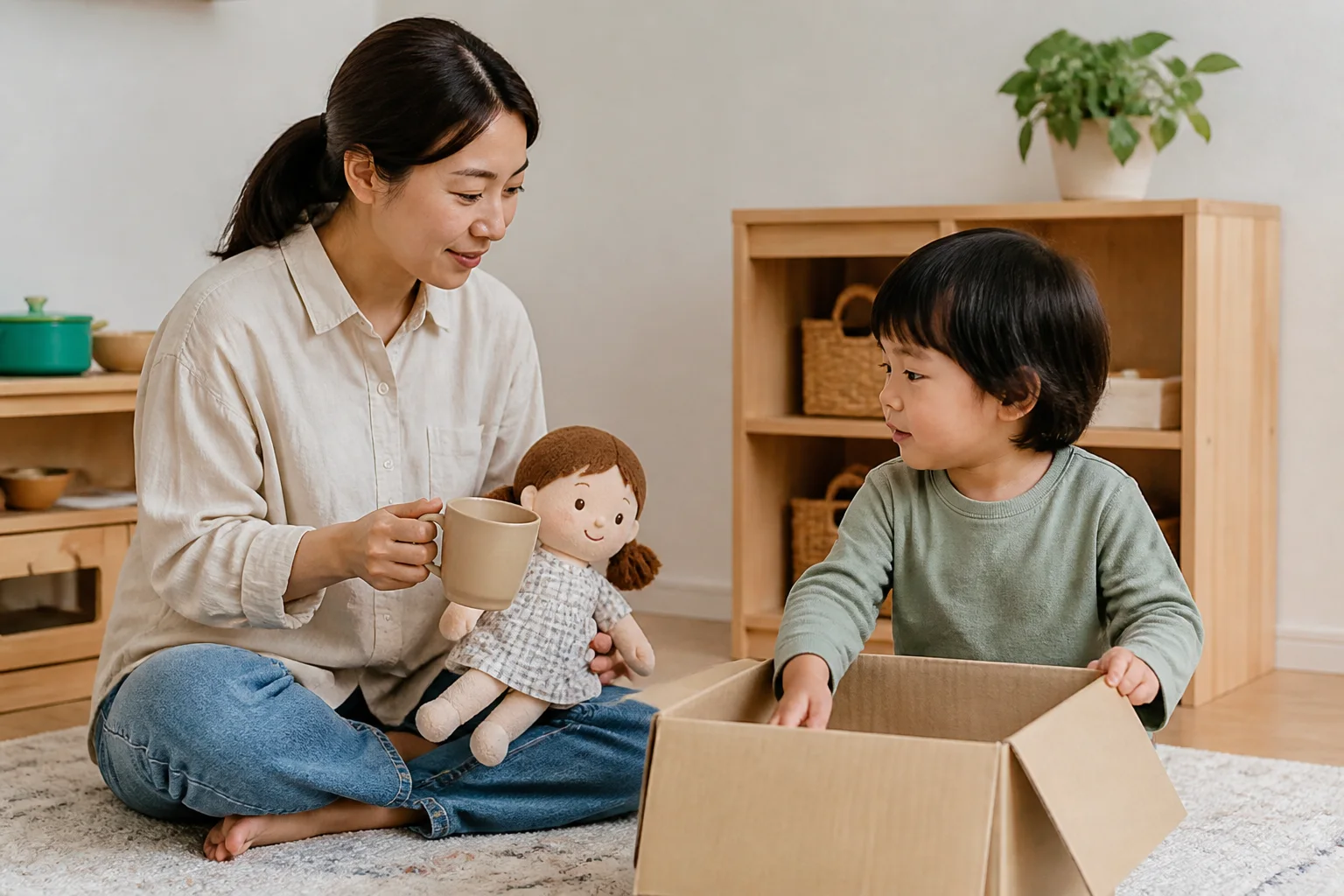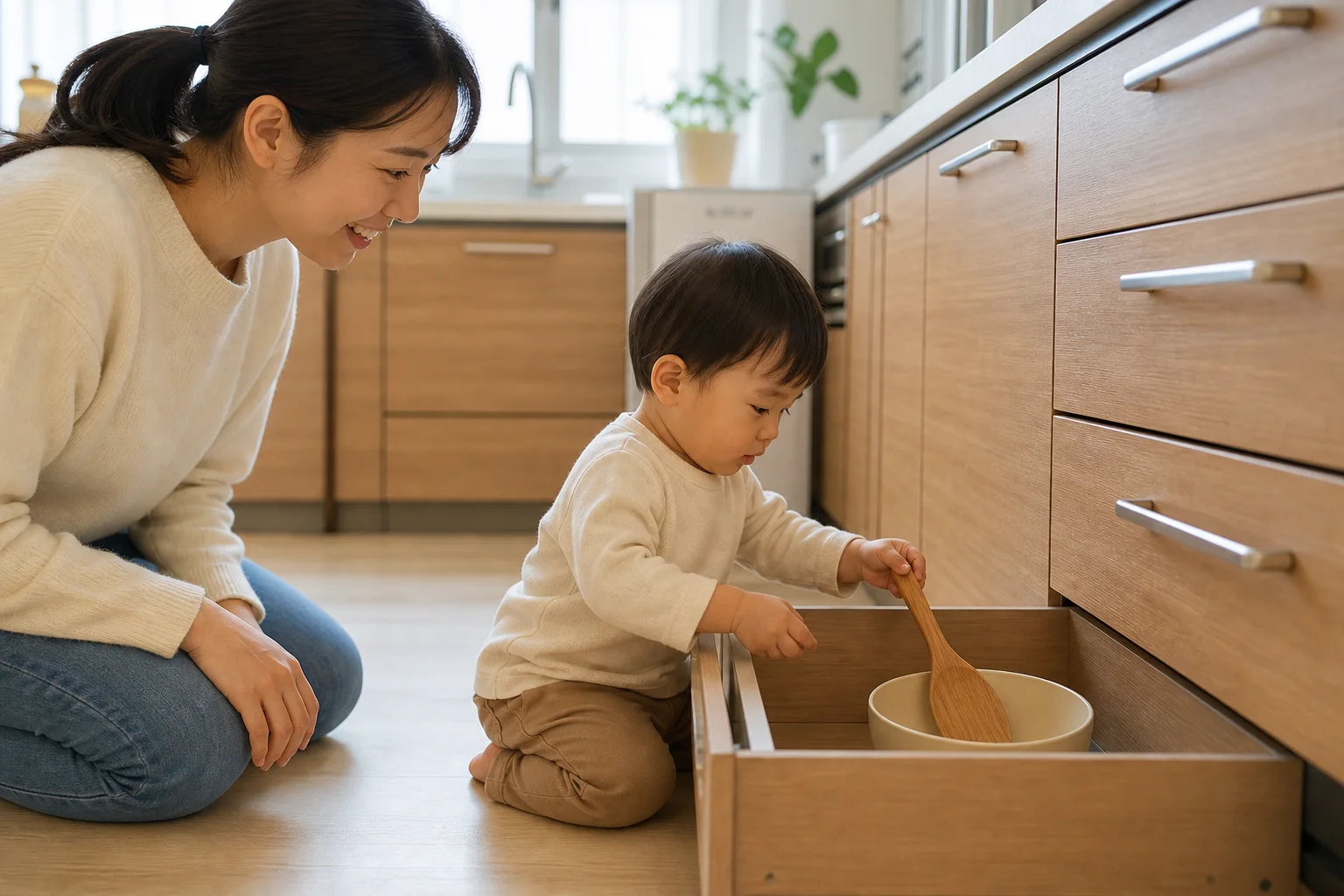
Your baby drops a ball, you pick it up, and they let go again. After a few rounds, you may wonder whether they are playing, testing you, or need to stop. You do not need to decide their intention from one action. On a safe floor, it may be play that explores sounds, movement, and your response.
Key point
Put a light, unbreakable object too large to swallow in a safe floor space and watch a few rounds of dropping and responding. Do not allow throwing near heights or toward people, animals, or glass as exploration. Persistent one-sided use or lost skills need separate medical advice.
What to remember
- Place one checked object at a time on the floor, such as a large ball, cloth, or safe large spoon.
- Respond briefly within a limit you choose instead of immediately picking it up every time.
- Stop throwing toward people, animals, or heights immediately and offer a safe action for their hands.
Do not immediately label dropping a bad habit
Babies may let go, listen to the sound, or watch a caregiver hand the object back, then repeat. Around 4 to 7 months, dropping objects and watching an adult pick them up is commonly seen during cognitive development. But babies do not all do this at the same time or for the same reason.
You can briefly describe what happened: "It fell. It made a sound on the floor," then wait. Instead of teaching a purpose or seeking a result, notice whether your baby reaches again, follows with their eyes, or turns to other play.
Make a small safe area on the floor
Play on the floor with a caregiver close by, not in a high chair, near stairs, or on a table. First clear glass, hard corners, small objects, and pets from the area. It is safer to prepare a space where dropped objects will not hurt someone or break than to specify where the baby must drop them.
Offer one object at a time. Choose age-appropriate items, such as a large soft ball, a large cloth without sharp decorations, or an intact large spoon that cannot be swallowed. Household items are not automatically safe. Check each time for small parts, loose lids, or cracks.
Repeat only as much as you can manage
You do not have to return the object immediately every time. You can set a manageable number and an ending: "Two more times, then into the basket." When finishing, show the next action instead of snatching it away: "The ball can rest in the basket. Now let's feel the cloth." Sleepiness or turning away also tells you it may be time to stop.
If repeated play wears you out, reduce the materials without judging your child. Switch to rolling one ball or folding a cloth into a box. There is no promise that repetition will improve intelligence or hand-eye coordination. Watching safe play together is enough.
Stop dangerous throws and teach the limit
Do not allow throws toward people, pets, glass, or screens, or near high chairs or stairs as exploration. Block the action, move the object somewhere safe, and say briefly, "We don't throw toward people. Let's roll the ball on the floor." Check anyone hurt before explaining the toy rule.
Laughing or looking back after throwing does not prove your baby is trying to manipulate you. Still, repeat the same limit for unsafe directions. If needed, remove the object and offer a soft cloth to hold or a large ball to roll.
Share more than the dropping when seeking advice
If your baby persistently uses almost only one hand, generally struggles to grasp and release, or has concerning visual or hearing responses, do not increase play repetitions to test them. Losing a hand movement or another previously used skill is also a reason to speak promptly with their pediatric healthcare professional.
Write down which hand held what, whether both hands are used in other positions, and when things changed. One dropping action does not establish a developmental problem, but share concerns and lost skills without waiting.
Worksheet
Safety checks before dropping play
First note where and with whom you will play, rather than what to drop.
- Floor area
- What you cleared away and where the caregiver will sit
- Today's object
- Check the large ball, cloth, or spoon for damage
- End of repetition
- The adult's chosen number or stop signal
- Notes for a consultation
- Observed facts about one-sided use or changing skills
Notes
- Small parts, magnets, batteries, glass, and sharp objects are not materials for dropping play.
- Immediately stop throws toward people, animals, or heights and switch to safe floor play.
- This play does not suit every situation. If the sound of falling objects frightens your baby, use a quiet cloth instead of a ball. If noise affects downstairs neighbors, or pets or crawling siblings are always nearby, try another repeated action, such as rolling or putting objects in a box.
References
- American Academy of Pediatrics: Cognitive development at 4 to 7 months
- U.S. Consumer Product Safety Commission: Toy safety
- U.S. Consumer Product Safety Commission: Small parts and choking hazards
This is general guidance on infant play and safety. It does not replace emergency care for choking or diagnosis and treatment of vision, hearing, or movement development concerns.