One large, safe prop and one action are enough to start. After a brief demonstration, give your child time to choose whether to continue. Not joining pretend play on one occasion does not establish anything about development.
Key point
Show one action with a large, safe prop, then wait for your child to choose.
What to remember
- Start with one large, safe prop.
- Let your child lead the roles and rules.
- Do not judge development from one response.
Show just one action
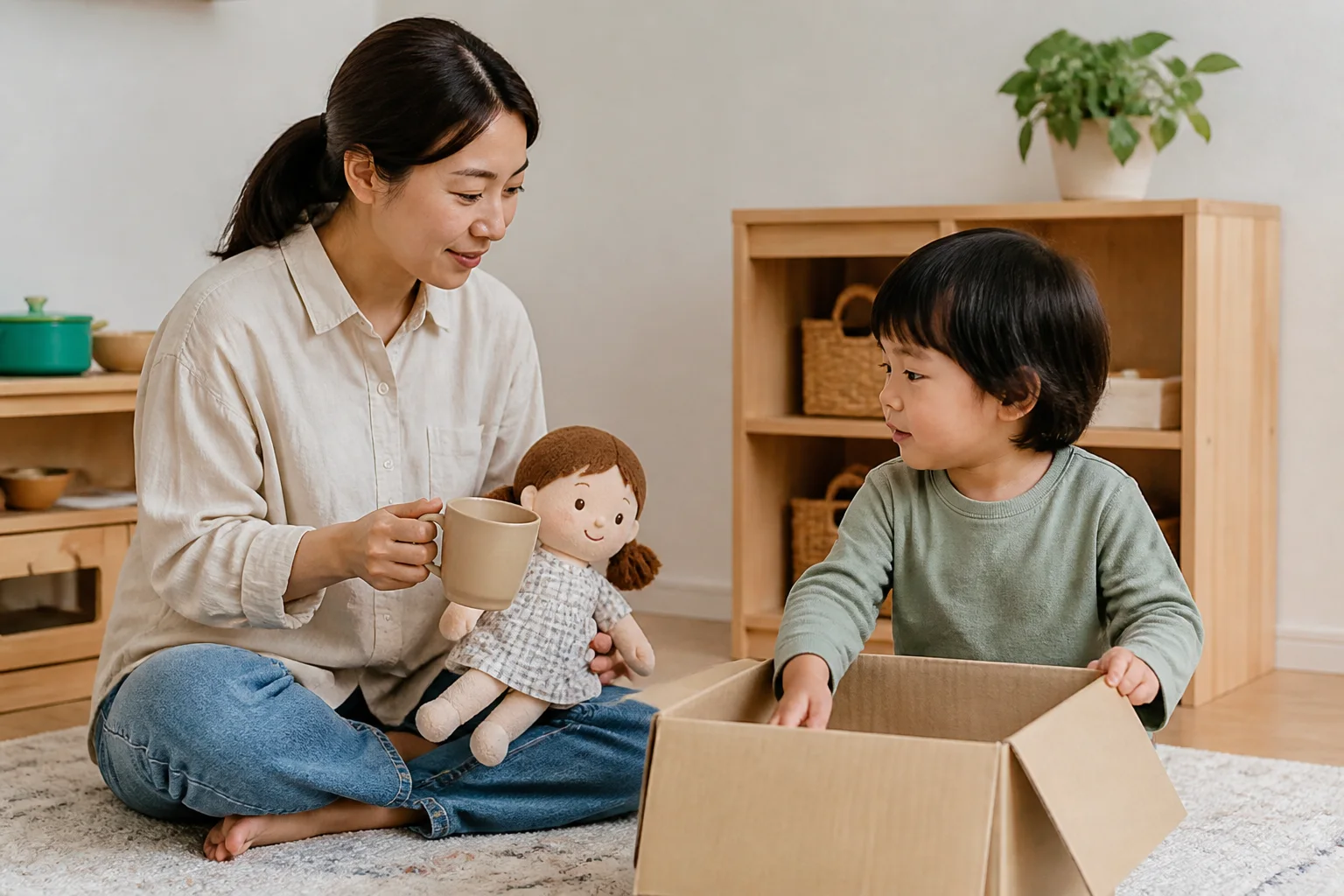
Hold an empty cup to your mouth and say, "Having some tea," or cover a doll with a blanket. This kind of pretend play may appear around ages 2 to 3, but its timing and form vary. Do not push your child to copy you. Follow along if they use the prop differently.
Let your child choose the next scene
After the demonstration, say something that does not ask for a right answer, such as "The doll's cup is here too," then wait. Leave room for your child to offer the doll a cup or choose another action. Do not immediately correct a different use of the cup or an upside-down box. You can describe what you see, such as "The box is a bus," or quietly copy your child. Let them lead the roles and rules.
A stream of "What's this?" and "What will you do next?" may make your child feel they need to find answers. If they push a box, slowly push another one. If they stop, stop too. When words are needed, briefly describe only the action you see.
Do not add more props if play does not continue
If your child shows no interest after one action, pause rather than bringing out many more props. Putting down the doll and moving to another activity is also a choice. Another day, start again with a familiar everyday scene, such as eating or bathing.
There are ordinary reasons play may not continue
Before concluding that your child is uninterested, look at the conditions. Too many props may make choosing hard. Repeated adult questions may feel like a quiz. Or your child may currently be absorbed in another kind of play, such as pouring and emptying. Leave one prop if there are too many. If you asked many questions, speak less and show one action. If they are absorbed elsewhere, add one small scene within that play, such as "Shall the doll ride too?"
Choose props for safety, not realism
Do not use real medicine, cleaners, hot cooking tools, plastic bags, cords, button batteries, or small parts as props. Use age-appropriate items, such as intact large cups, cloth dolls, and empty boxes, with adult supervision. Household items are not automatically safe, and damaged toys should be removed.
Look at concerns across several situations
You can write one line about what your child picked up and how they changed your demonstration. Playing alone or differently from the adult does not mean poor social skills or failure.
If several milestones, such as speech or movement skills common at that age, are absent beyond pretend play, previously used skills are lost, or interactions are concerning across situations, describe what happens to a healthcare professional.
Worksheet
One scene to begin pretend play
This card is not something your child must copy. It keeps the start small, with one safe prop and one brief action.
- Safe prop
- One large cup, doll, or box
- One action
- Drinking, covering, or pushing
- Words before waiting
- One comment without a required answer
- Child's choice
- Continue, change it, or move to another activity
Notes
- If your child does not copy you, you can leave the prop available or move to another activity.
- The card is not a developmental test, treatment, or a correct answer for a role.
- Do not use real medicine, cleaners, batteries, or small parts as props.
- The same start does not suit every child. Follow children who prefer a familiar everyday scene to a new prop, or who explore alone before inviting an adult.
References
- CDC: Positive parenting tips for ages 2 to 3
- CDC: Child-led play tips
- CDC: Developmental milestones
- U.S. Consumer Product Safety Commission: Toy safety
This is general guidance on pretend play. It does not replace developmental assessment or treatment.