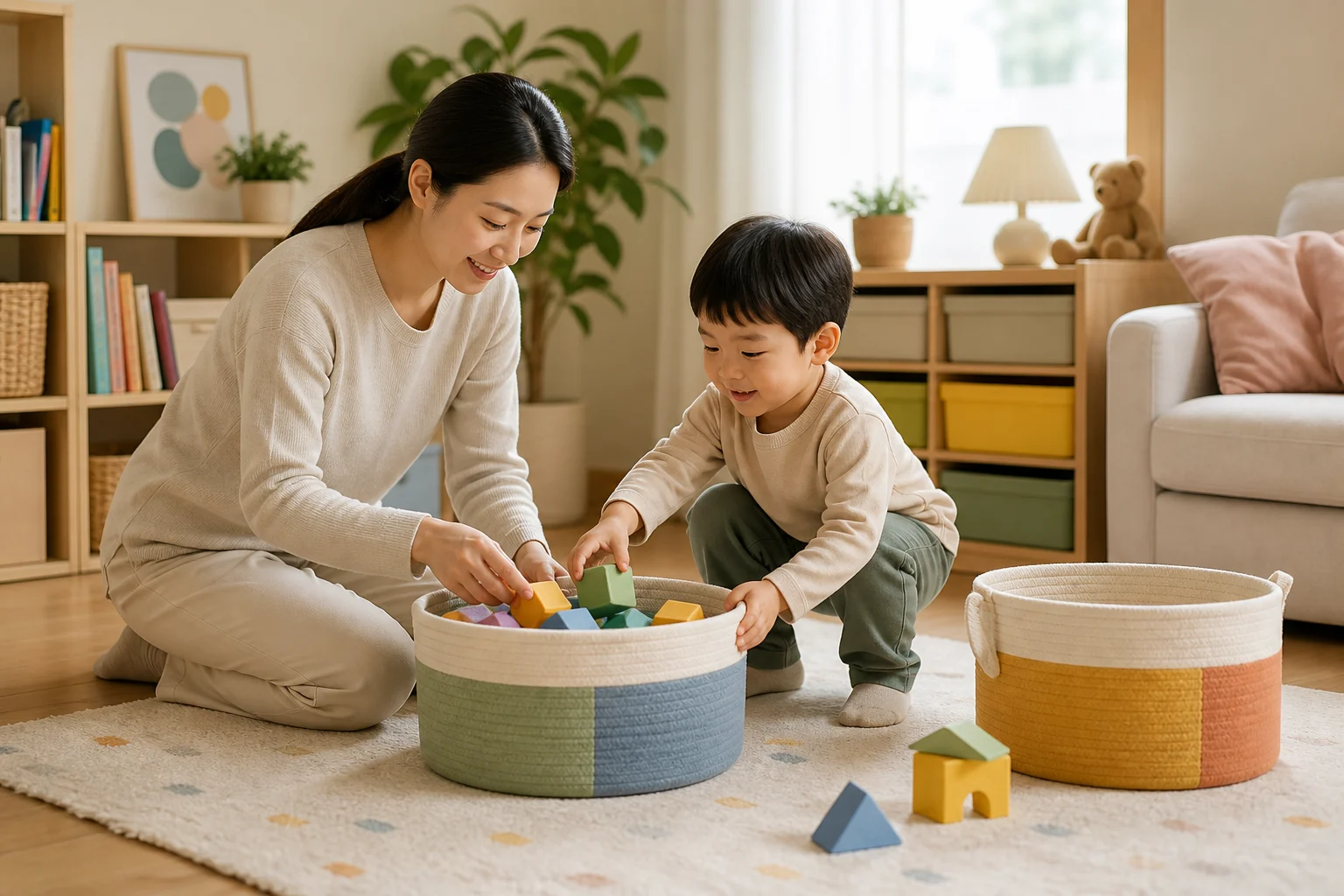
When you say "Clean up" after all the blocks are out and your child starts another game, you may wonder how much to help. Before calling it laziness or bad manners, consider whether the task feels too big or your child does not know where to start. Try one basket instead of the whole floor, or a step with a clear endpoint, such as "Let's put three blue blocks in this basket," instead of "Do it all."
Key point
Put away a few items first to show how to start, then give your child one type of toy or one area. You can try slightly increasing their part next time, but reduce it again if it is difficult. Adults handle dangerous items. If difficulties with understanding, movement, or sensory demands persist across situations, adjust the environment or seek advice.
What to remember
- Break cleanup down into one area, one type of toy, or one action instead of the whole floor.
- If you say "Let's do it together," sit down in the same space and actually start helping.
- Do not assign children small parts, magnets, batteries, broken items, sharp objects, or heavy boxes.
Start with one instruction that has a clear endpoint
"Clean up" may bring the floor, shelves, and several baskets to mind all at once. Move closer and calmly describe one specific action at a time. When play is over, point to both the item and its place: "Let's put the cars in this basket" or "Let's move just the big blocks into the box."
After speaking, wait briefly instead of immediately repeating yourself or adding another instruction. When your child puts one item away, describe what you see: "The car is in the basket."
Start yourself, then give your child one part
At first, the caregiver does most of it. Gather the big blocks while your child puts one matching block in the basket. As this becomes familiar, hold the basket while your child moves the blocks. On a hard day, it is fine to start together again.
"Let's do it together" means more than watching. Sit on the floor and use your hands, too. If your child wants another game, say, "Let's fill this basket, then choose the next game." Set the amount and pace according to what your child can do today, not as a measure of age or ability.
Make storage areas and baskets safe
Keep baskets low, stable, and within reach, and anchor shelves and storage furniture to prevent tipping. Keep walkways, doorways, and emergency exits clear. An adult should first gather and check small parts, magnets, button batteries, broken toys, sharp objects, and heavy boxes. Never make a child pick up fragments or batteries as punishment.
Check toys for age labels, damage, and small-part hazards. When play involves many materials, separate items that need safe storage from the large materials your child will put away today instead of pushing everything into one basket. Do not throw everything out without warning or delay meals, bathroom access, or sleep until cleanup is done.
On difficult days, look at the environment again
If your child struggles to stop playing, note whether the basket was far away, whether noise, fatigue, or hunger played a part, or whether too many materials were mixed together. Next time, offer just two types of toys, give one reminder a few minutes before stopping, or define a small cleanup area with a low mat.
A short, predictable cleanup routine can reduce the need to negotiate each time. But colored baskets cannot guarantee cooperation or independent cleanup habits. If the same conflict keeps happening, try using fewer words and putting out fewer items.
Look for difficulties beyond cleanup
Look for trouble understanding instructions during dressing, meal preparation, and play as well as cleanup. Notice difficulty moving or focusing, or discomfort with sounds or textures. If these difficulties continue, do not assume your child is simply refusing to listen. Note which words make them stop and which materials or spaces are harder, then adjust the environment and support.
If these difficulties last and put a major strain on family life, or your child loses skills they previously had, ask a pediatrician or relevant support service. This cleanup routine does not replace developmental assessment, diagnosis, or treatment. The priority is to end play in a way that keeps both child and caregiver safe.
Worksheet
A Shared Cleanup Sequence
This card separates the caregiver's jobs from one action the child can try. It is not a chart for adding more responsibility today.
- One area
- One part of the floor, mat, or shelf to clean up together today
- Adult first
- Dangerous, heavy, or broken items for an adult to handle
- One shared action
- One task, such as "Let's put the big blocks in the basket"
- Your child's part
- One type of toy or one action they tried comfortably today
- Next choice
- The next game or everyday transition after cleanup
- Observations
- What you noticed about the number of items, fatigue, noise, or understanding directions
Notes
- The amount and pace assigned to a child are not measures of developmental stage or independence.
- Keep walkways and emergency exits clear. Adults handle small parts, magnets, batteries, broken items, sharp objects, and heavy boxes.
References
- Centers for Disease Control and Prevention: Steps for giving good directions
- Centers for Disease Control and Prevention: Using routines and rules
- Centers for Disease Control and Prevention: Creating rules
- U.S. Consumer Product Safety Commission: Toy safety
This is general guidance on ending play and adjusting the environment. It does not replace developmental, sensory, or motor assessment or treatment, or a home-specific safety assessment.