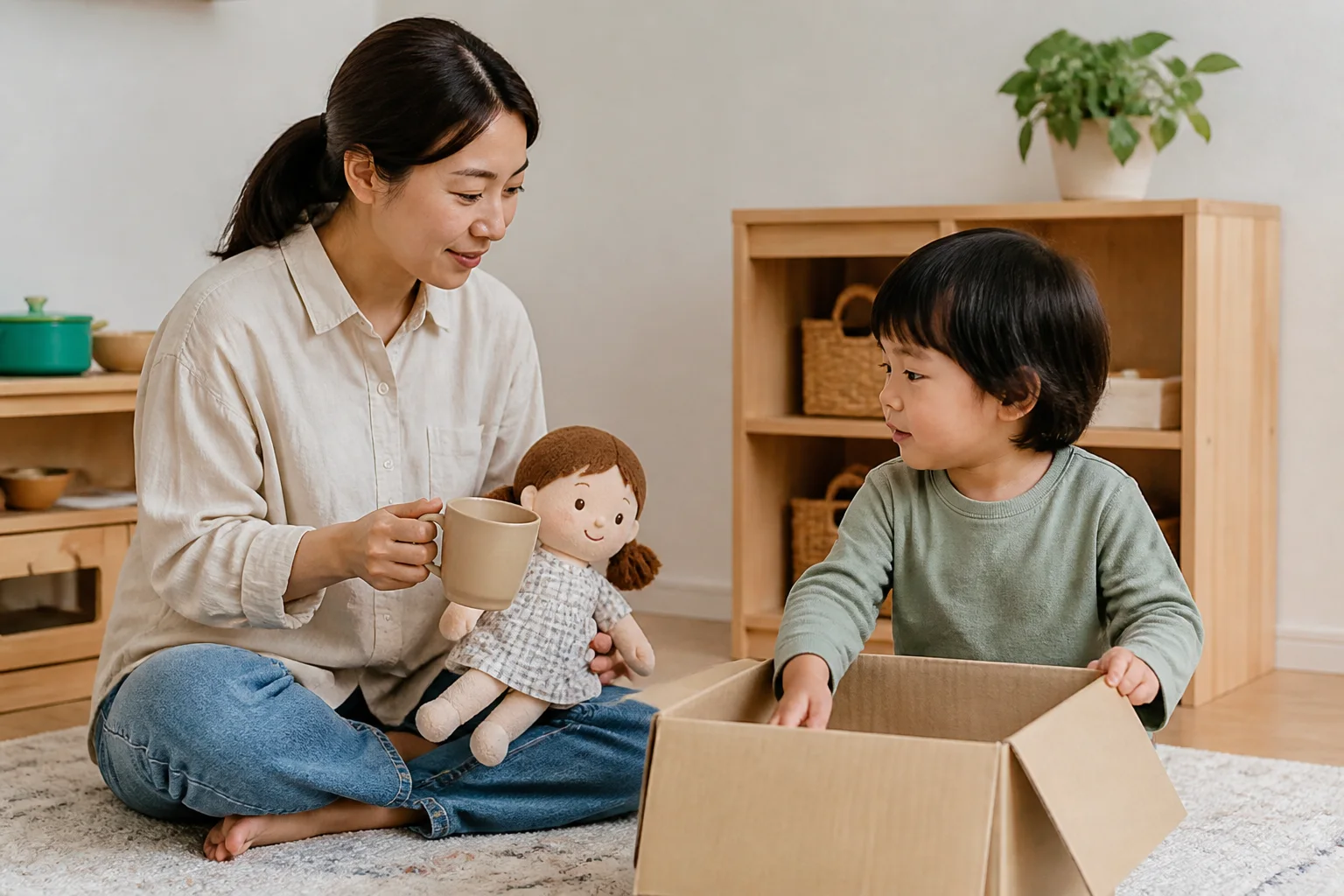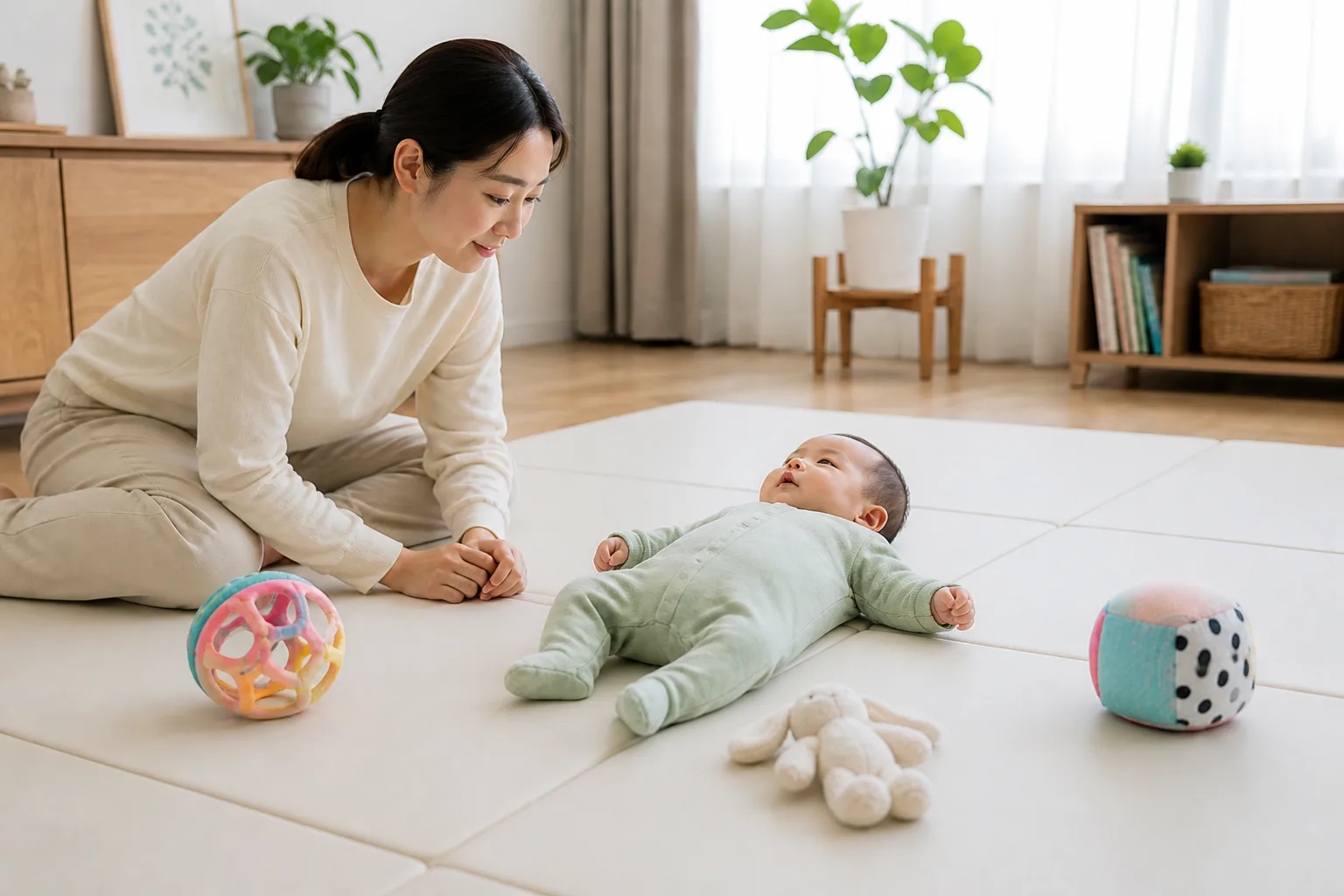
While your baby is awake and you are nearby, place one easy-to-grasp toy on a safe floor. Do not move it farther away or pull an arm to make your baby reach. Sleepiness, position, sounds, and light can affect the response. Watch whether your baby can look and move comfortably instead of judging one play session.
Key point
Let your awake baby play on a safe floor. Place a toy in front of the chest, then on the left and right, and watch the eyes, both arms, and body direction together. No specific placement guarantees development. If you notice a concerning sign, discuss it at an appointment instead of waiting.
What to remember
- Place one safe, easy-to-grasp object where your baby can see and may be able to reach it.
- Try the center, left, and right in turn, without pulling your baby's hand or rushing a successful reach.
- Tell a health care professional if your baby rarely uses one arm, loses a skill, or shows an overall change in movement.
Start with a simple play space
Begin on a firm floor space while your baby is awake and you are nearby. One object without small parts, sharp edges, or breakable pieces is enough. Do not practice reaching by placing toys on a bed or couch or among soft cushions.
First place the object in front of your baby's chest and within sight, then watch their expression. If your baby turns their head or follows it with their eyes, wait quietly. If a hand does not move right away, avoid shaking the object more and more. Respect signs that your baby needs a break or wants to look away.
The center and both sides are an observation sequence, not a comparison
During the next play session, put the same object on the left. At another time, put it on the right. There is no single distance that suits every baby. What matters more is finding a spot where your baby can move an arm or turn the body slightly without grimacing or straining hard.
From the center, watch whether both hands move together. From the side, notice whether the eyes move first and whether the body turns that way. It is fine if one hand brushes the toy without grasping it. When success means grasping the toy, caregivers may keep moving it or move the baby's arm for them.
Record responses briefly and do not rush to interpret them
After play, write only what you saw, such as, "Looked at the soft cloth book in the center for a long time," "Moved an arm twice when it was on the right," or "Turned the head to the left, then started crying." Also note whether your baby was getting sleepy, had just eaten, or heard an unfamiliar sound. These details can help you adjust the setting next time.
There is a reason not to start with a conclusion such as, "My baby cannot use the right hand." Fatigue and position may lead a baby to look more toward one side, and one play session cannot show every usual movement. Watching the same situation over several days, along with other daily activities, is also more useful when speaking with a health care professional.
Developmental milestones list skills to look for at each age
Developmental milestones include holding a toy placed in the hand and swinging an arm toward toys at around 4 months, and reaching for a wanted toy at around 6 months. These lists describe skills that many children commonly show. A single item cannot diagnose a child.
If a milestone concerns you or you keep feeling that something is not right, ask at a pediatric visit about developmental screening. Milestone materials do not replace standardized, validated developmental screening tools. There is no need to force a toy into a certain position to match a monthly chart.
Do not take over the play while trying to help
Do not pull your baby's arm toward the toy or tie an object to the hand. Opening a hand and looking before grasping are also parts of play. You can describe what you see by saying, "You are looking at it. Your hand moved." Put the object away when your baby loses interest and try again another time.
To vary the stimulation, use one safe object with a different texture or quietly move the same object to the other side instead of bringing out many new toys. Depending on age, you may also see your baby briefly hold a toy placed in the hand and move the arm. A short grasp is not a reason to increase practice time.
Bring your notes to an appointment in these situations
Do not keep testing through more play sessions if your baby rarely uses one arm, the difference between the arms continues to look large, the body looks unusually stiff or floppy, or following with the eyes seems difficult. Losing hand or arm movements or any other skill your baby used to have is also a sign to report right away.
At the appointment, explain when one side began responding differently and whether you see the same pattern while your baby is awake or being held. Ask whether you may show a video or notes and whether developmental screening is needed. If your baby was born prematurely or is already receiving care for a neurologic, muscle, or vision condition, follow the health care team's plan before a general age chart.
Worksheet
Three-Position Response Chart
Record the conditions in which your baby was comfortable, rather than counting successes on the same day.
- Center of chest
- What your baby saw, hand movements, and signs of stopping
- Left
- What you observed in the eyes, arms, and body direction
- Right
- What you observed in the eyes, arms, and body direction
- Next appointment
- Ongoing concerns and records to show
Notes
- Keep objects with small or detachable parts, strings, or sharp edges out of a baby's play space.
- Use these play ideas only while your baby is awake and a caregiver is nearby.
References
- Centers for Disease Control and Prevention: Developmental milestones and what to do about concerns
- Centers for Disease Control and Prevention: 4-month developmental milestones checklist
- American Academy of Pediatrics: Your baby's movement and play
This is general play and observation guidance. It does not replace diagnosis or treatment of developmental, vision, neurologic, or muscle conditions.