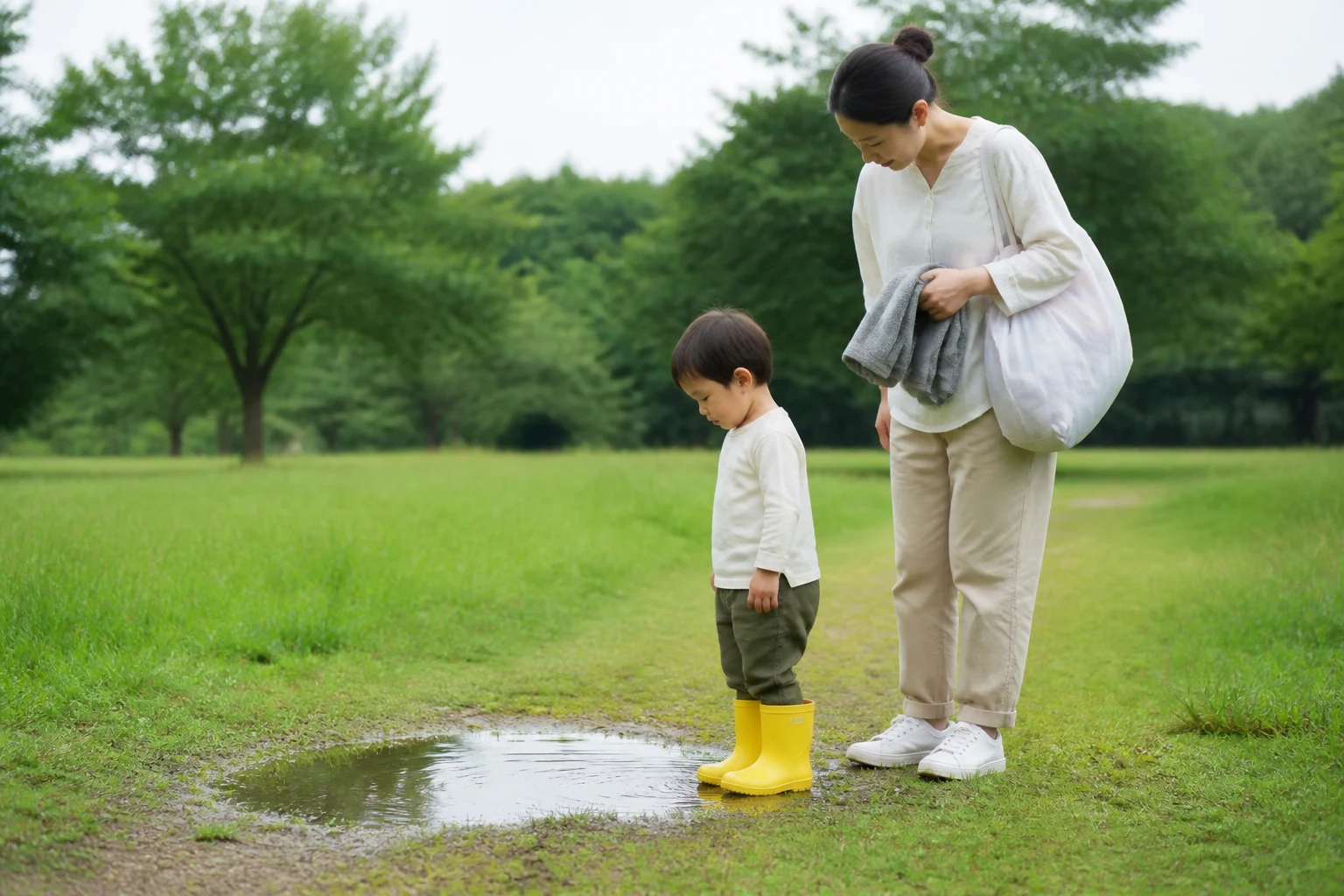
After the rain stops, your child may want to put on boots and jump into a puddle. Before getting the boots, decide which water is off-limits. Even if it looks shallow, water near roads or drains and floodwater are not places to play.
Key point
A shallow puddle with a visible bottom is not necessarily safe. Stay out if flood or contamination risks or access restrictions are unclear, and follow the site's official guidance on whether play is allowed. If you see lightning or hear thunder, go indoors immediately.
What to remember
- Stay out of floodwater and water on roads, in parking lots, or near drains.
- Follow the site's official guidance on whether play is allowed. Even where water play is permitted, an adult must stay close and supervise continuously.
- If you hear thunder or see lightning, move indoors or into a hard-top vehicle with the windows closed.
Choose the location first
Water left by rain does not all carry the same risks. Floodwater can contain contaminants, sharp objects, electrical hazards, and drowning risks. Do not let children enter or play in it. Avoid standing water near roads, parking lots, drains, and construction sites even if it looks shallow. Boots and waterproof clothing do not make this water safe.
Seeing the bottom and judging the depth cannot tell you whether the water is contaminated. Stay out if flood or contamination risks or access restrictions are unclear. Follow the site's official guidance on whether play is allowed. Also stay out of moving water or water whose depth you cannot judge. Make the boundary clear: "There is water here, but this is not a place to play."
Lightning and thunder mean it is time to leave
If you see lightning or hear thunder, stop water play without taking time to remove boots or get another photo. Move indoors or into a hard-top vehicle with the windows closed. Public safety guidance says not to resume outdoor activities for at least 30 minutes after the storm.
Lighter rain alone does not mean it is safe. Even if your child wants to keep playing, say briefly, "Thunder means play is over today. Let's go inside," and leave. The 30-minute wait is a safety rule to avoid lightning danger, not a punishment or a test of your child's patience.
Check before entering and stay beside your child
Even where official guidance permits water play, an adult should check for slippery ground, glass or metal fragments, changes in depth, and nearby vehicles. These checks alone do not establish that the water is safe. Stay close and watch continuously during water play. Do not let a phone or another task interrupt supervision. Do not focus only on taking photos or ask a sibling to supervise.
If your child has an open wound, choose to stay out of the water. Covering a wound with a waterproof dressing does not make contaminated water safe. Keep your child from drinking the water or splashing it onto their face. At home, wash hands and body and change wet clothes and shoes. Stop play and seek appropriate medical advice if your child feels unwell or has concerning skin changes.
Write down supplies and reasons to leave
Pack boots, a change of clothes, and a towel. Agree to avoid roads, drains, and floodwater; leave immediately if you hear thunder; and stay near an adult who checks the ground and depth. Having boots does not mean you can enter unsafe water.
Before leaving, you can discuss one or two brief questions: "Which water should we stay out of?" and "Where will we go if we hear thunder?" If you find unsafe water or the weather changes, change your plans and go home right away. Do not compromise on an unsafe location to ease disappointment.
Leaving safely is part of play
After saying, "That's all for today," help your child dry off and change into dry clothes. Base any decision to go out again on safe weather and surroundings rather than a promised time. After flooding, follow local notices and access restrictions for public spaces.
If your child swallowed water, was injured, or may have touched contaminated water, tell a healthcare professional about the situation and any symptoms. If you feel the conditions are dangerous, move somewhere safe instead of trying to extend the experience.
Worksheet
What to Check Before Puddle Play
First identify water to stay out of and weather that means going indoors immediately.
- Location
- Have you avoided floodwater and water near roads, parking lots, drains, and construction sites, and checked contamination concerns, access restrictions, and official guidance on play?
- Weather
- Is there any lightning or thunder, and will you head indoors if it occurs?
- Ground
- Has an adult checked depth, slipperiness, and dangerous objects?
- Supervision
- Can an adult stay close and watch continuously?
- Going home
- Have towels, dry clothes, and a plan to wash hands and body ready
Notes
- Boots and raincoats cannot protect against floodwater, contaminated water, or lightning. Cancel play in these conditions.
References
- Centers for Disease Control and Prevention: Floodwater safety
- Centers for Disease Control and Prevention: Lightning safety
- Centers for Disease Control and Prevention: Outdoor play and safety for children
- Centers for Disease Control and Prevention: Reopening outdoor public spaces after flooding
This is general outdoor play safety guidance. It does not replace weather alerts, flood response instructions, or medical treatment.