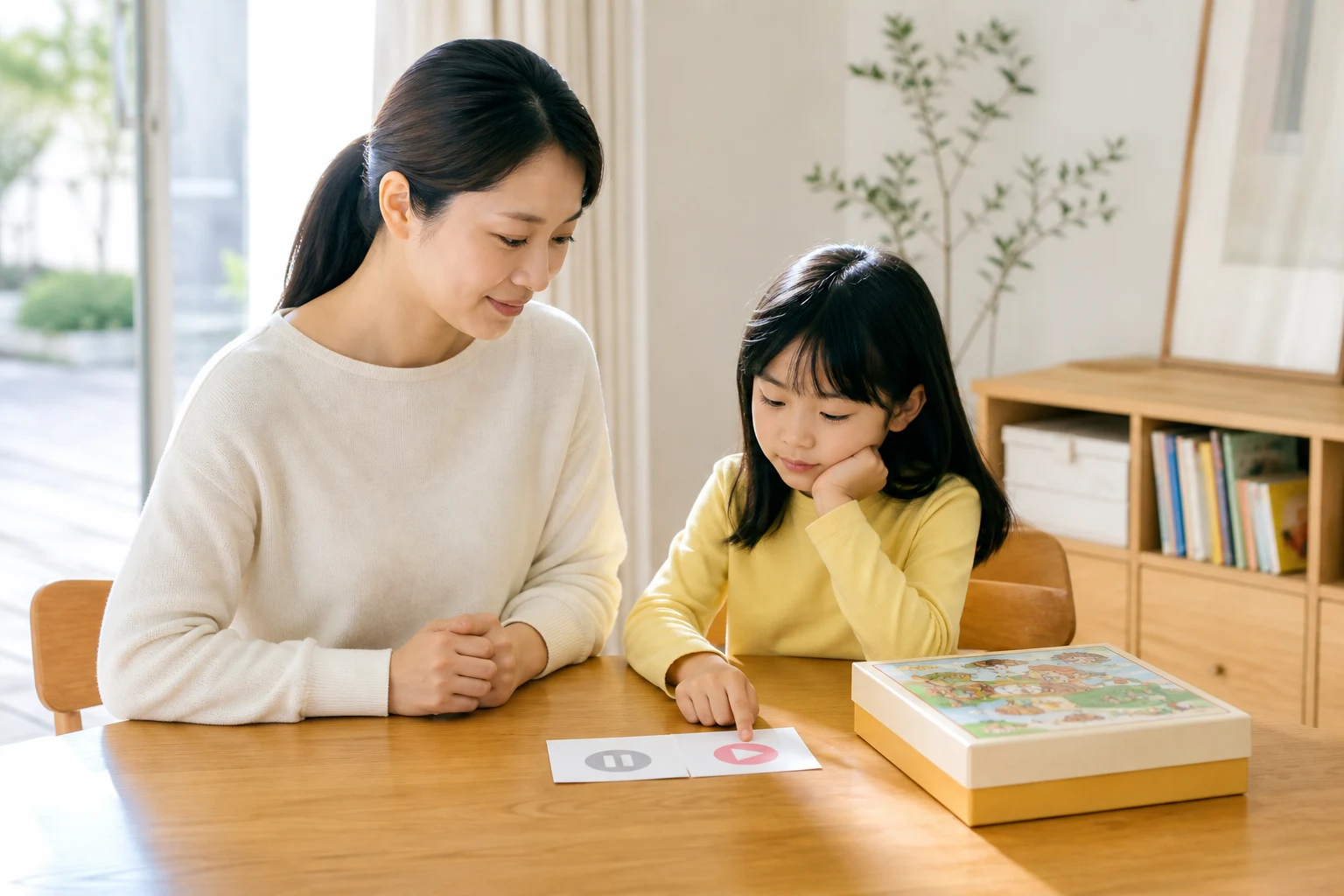
Laughter alone does not mean play should continue. Agree on signals before starting. When someone gives the stop signal, separate and make space immediately. End the play if it involves risks to the head or neck, putting body weight on someone, or signs of injury.
Key point
Agree on signals and have an adult supervise. Keep risks to the head or neck and putting body weight on someone out of play.
What to remember
- Let everyone choose whether to participate.
- Take your hands off immediately at the stop signal.
- End play when there are signs of injury.
Agree on three signals before starting
During a calm moment, choose words and hand signals for start, gentler, and stop. Define the action too: "Start only when both people want to," "Gentler means show an open palm," and "Stop means raise a hand and move apart." These signals are an agreement about what to do before play. They are not treatment or a test.
Rough play usually escalates for a reason
If the same physical play is fun one day but quickly becomes intense on another, look at the conditions instead of the child's personality. Excitement may have built as play went on, someone may have mistaken laughter for permission to continue, or a child may still be learning how to use less force. If excitement keeps building, pause often for short breaks. If someone treats laughter as permission to continue, explain, "Even when someone is laughing, you must stop when they give the stop signal." If controlling force is hard, switch to a lower-intensity action such as a seated high five.
Body signals also mean stop
Separate immediately if someone says stop, raises a hand, stiffens, or moves away. Ask, "Do you want to keep playing?" and respect the choice not to join. Do not ignore a signal because the person is laughing. An adult should supervise nearby.
Reduce space and intensity risks first
Use a nonslip floor and block access to furniture, windows, stairs, and sharp corners. Start with low-intensity actions such as sitting and touching palms. Adjust the activity and distance to each person's needs.
After stopping, do not start by asking who was wrong
After a stop signal, first create space and check for injuries. Instead of a long "Why did you do that?" in the moment, say what to do next: "Move your bodies apart and get some water now."
Set new conditions before starting again
Start again with one low-intensity action only if both people seem comfortable and an adult is nearby. Switch to another activity if either person hesitates or stop signals keep happening. When a child follows the stop signal, describe the action rather than the outcome: "You took your hands off right away."
Decide which actions are never part of play
Do not allow choking, pressure on the head or neck, throwing someone, an adult putting body weight on a child, or forcing someone to endure tickling. If any of these happens, say, "Bodies apart," and separate immediately. Do not claim that rough physical play itself increases or decreases aggression, courage, or attachment.
End play when there are signs of injury
End the activity and seek appropriate medical care for pain, dizziness, a blow to the head, trouble breathing, or a change in consciousness. If the intensity repeatedly rises or stopping remains difficult, record the time, place, and signals to use in safety planning and consultation.
Worksheet
Four Agreements Before Physical Play
Choose the words and actions together before starting. This is not a scorecard for intensity or consent.
- Start
- Words for asking whether both people want to play
- Gentler
- A low-intensity action
- Stop
- Words, a hand signal, and immediate separation
- Safety
- Actions to avoid and a check of the space
Notes
- Do not start if either person hesitates or moves away.
- Start, gentler, and stop signals are not treatment, a test of the ability to consent, or a standard for impulse control.
- Stop immediately for pressure on the head or neck, throwing, putting body weight on someone, or signs of injury.
- Physical contact play will not suit every child or every day. If a child is injured, pause physical play and get any medical care needed first. If the child is uninjured but dislikes touch, try an activity without body contact, such as stacking pillows.
References
- CDC: Physical activity and play safety for children
- CDC: Safety planning considerations
- CDC: Tips for active listening
This is general safety guidance for physical contact play. It does not replace injury assessment or behavioral, sensory, or developmental treatment.