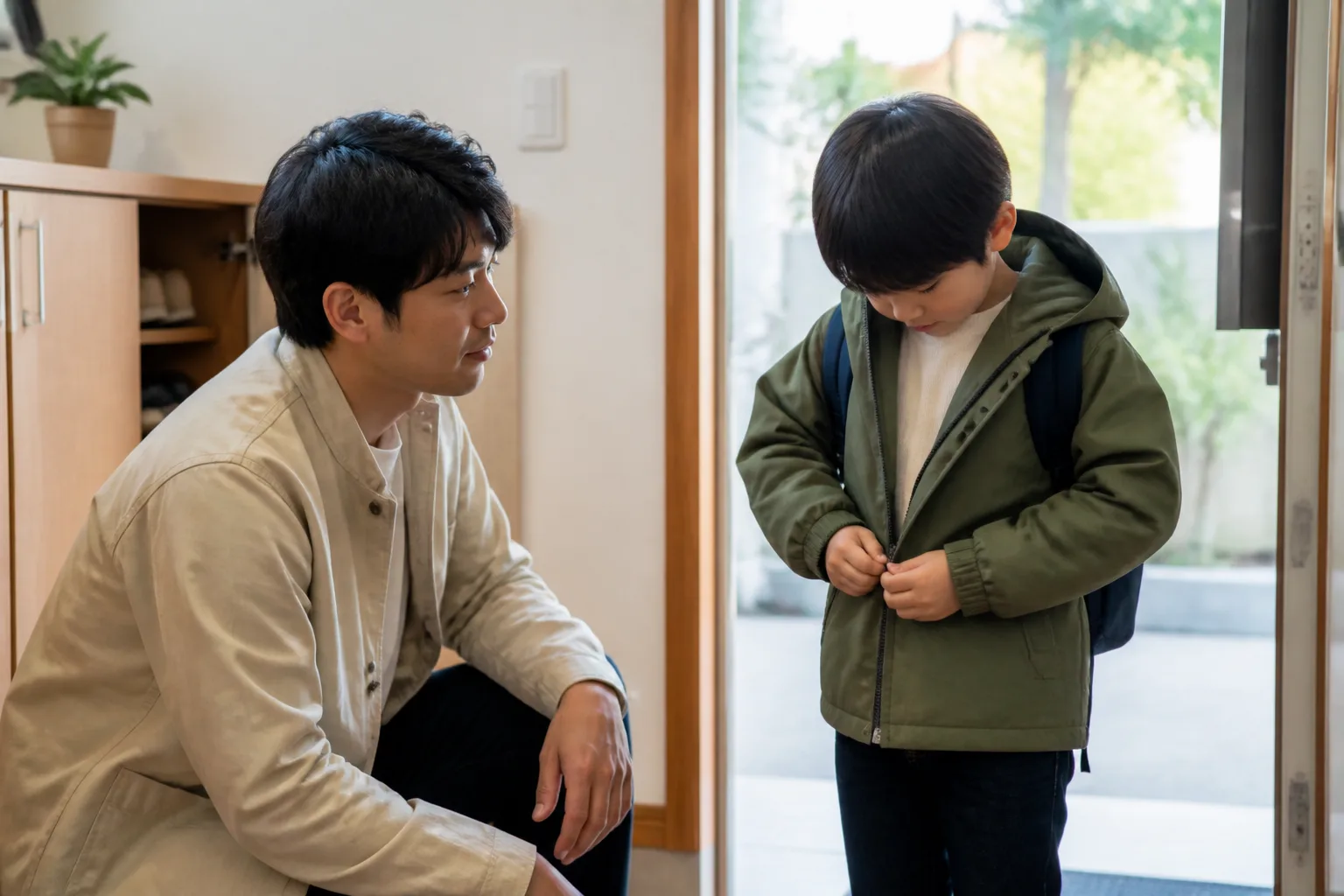
At the door, your hand may move first when your child misses the zipper several times and you fear being late. You may also want to finish before the child cries. But always taking over leaves fewer chances to see what the child was trying to do. Making the child struggle too long can also cause you to miss a request for help. The goal is to choose the right level of help, not simply to help less.
Key point
For daily tasks, treat waiting, giving one hint, working together, and helping directly as choices instead of a fixed order. Block danger and help immediately around unsafe places and tools. Pain, difficulty using one side, lost skills, or ongoing trouble with several tasks are signs to seek professional support, not discipline problems.
What to remember
- First look at your child's goal and what is dangerous now, then choose the level of help.
- Give one specific hint at a time. If the child is stuck, work together or help directly.
- Do not wait around traffic, water, fire, heights, sharp tools, or chemicals. Block danger immediately.
See what your child is trying to do before helping
If your child is holding a cup, pause to see whether the child is moving water, trying to drink alone, or playing. Naming the goal, such as, "You are moving the water," can also slow the caregiver's rush. If the child looks for help or has stopped, do not insist only on waiting.
A task needs to fit the child's age and current ability. Do not turn repeated failure with an oversized button or heavy bag into a lesson in independence. Leave one part for the child to try and adjust the rest yourself.
Choose among waiting, a hint, working together, and direct help
First, you may wait briefly. If your child's hands are moving, you can watch without correcting right away. Second, give one short hint, such as, "Hold the bottom of the zipper." Third, work together. You can hold the zipper steady while the child pulls it up. Fourth, help directly. If there is no time or the child is tired, finish the task yourself.
You do not always need to begin by waiting. The same child may need direct help on a busy morning and have time to try alone on a weekend. Receiving help does not mean dependence, and waiting a long time does not guarantee independence.
Say one thing at a time
Use specific words and give one direction at a time. "Let's take your socks out of the drawer" makes the next action clearer than, "Get dressed, pack your bag, and put on your shoes." When you say, "You put your foot in," you show the child the current step without judging it.
After a mistake, replace, "You spilled again," with, "Water fell on the floor. Let's get a towel and wipe it together." Leave a part the child can wipe, but secure safety first if someone could slip or there is broken glass.
Help immediately in a dangerous moment
Do not wait and ask, "Want to try?" near traffic, water, fire and hot objects, heights, sharp tools, or chemicals. Immediately move the child or object toward safety and briefly explain why. Offer a safe way to join instead: "I will use the knife. You can put the washed vegetables in the bowl."
Direct help in this moment does not take away the child's challenge. Blocking danger is an adult's responsibility. You do not need to frighten the child or allow a mistake on purpose to teach a lesson.
Keep signs for professional support separate from stubbornness
Do not treat it as simple laziness if your child has clear difficulty using one hand or leg, reports pain, loses a movement used before, or keeps getting stuck across several activities such as dressing, eating, and playing. Developmental milestones are not a test that diagnoses your child. They are a starting point for sharing a caregiver's concerns with a medical professional.
At the appointment, show notes about which tasks were hard, when the difficulty began, how much help was needed, and whether there was pain, tiredness, or difficulty using one side. Do not guess why your child avoided trying. Share facts about safety and function. Getting needed help is not the child's failure. It is part of understanding the current difficulty.
Worksheet
Four ways to help your child
For today's task, separate possible help from danger that needs immediate help.
- Child's goal
- One thing your child was trying to do
- Wait or hint
- A cue to watch for and one sentence
- Work together
- Parts for the parent and child
- Help now
- The danger and the direct action to take
Notes
- Direct help that blocks danger is not overprotection.
- A mistake or request for help is not a reason to label a child.
References
- Centers for Disease Control and Prevention: How to support child-led play
- Centers for Disease Control and Prevention: Steps for giving good directions
- Centers for Disease Control and Prevention: Developmental milestones
This is general guidance for helping with daily tasks. It does not replace diagnosis or treatment for pain, motor difficulties, or developmental concerns.