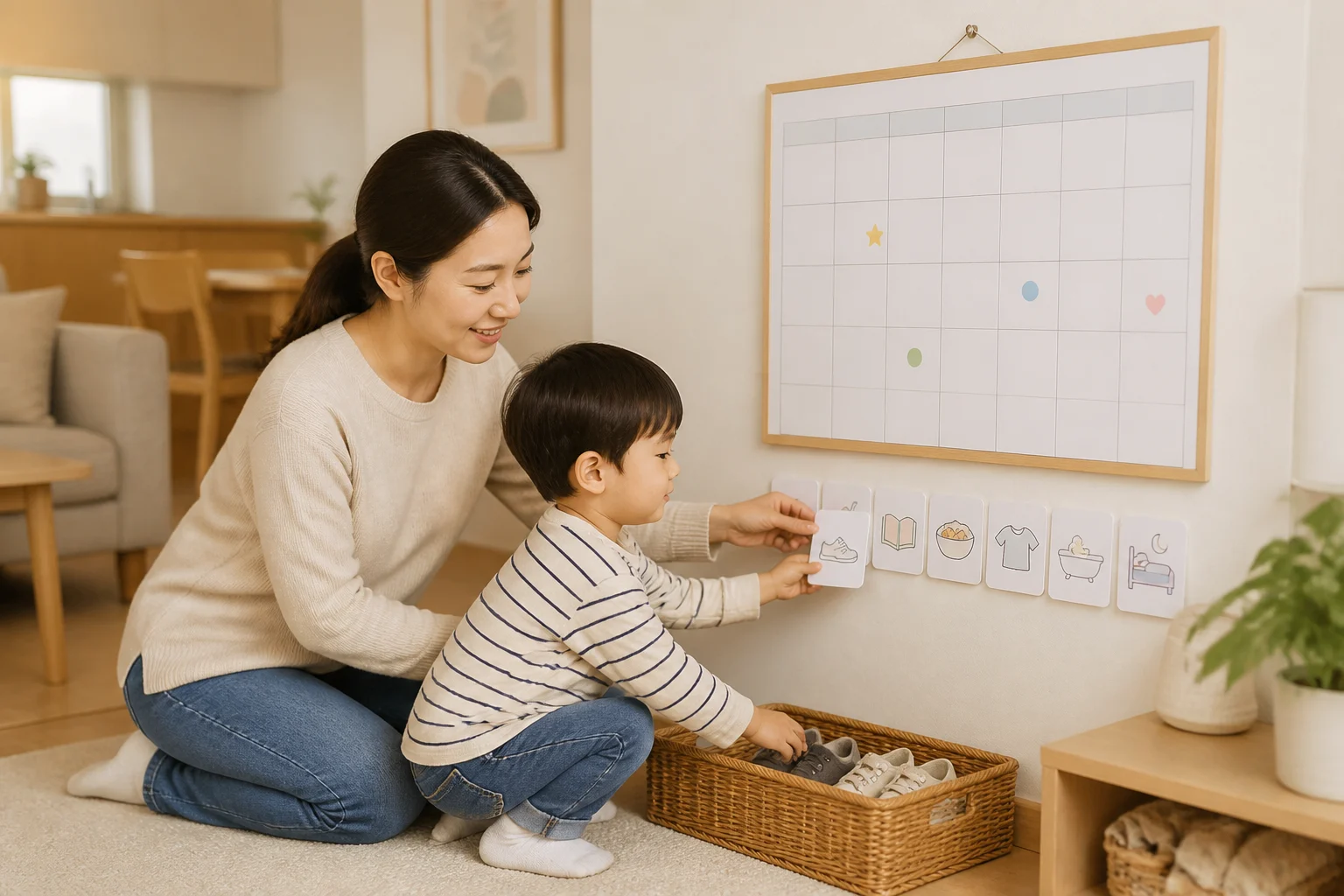
It is easy to judge parenting by visible results. Your view may shift when you ask whether you prevented danger or found a chance to reconnect today, rather than whether your child never cried or was ahead of other children.
Key point
When you wonder whether you are doing enough, review four areas: keeping your child safe, responding to them, talking again after mistakes, and resting yourself. Choose one action in the area where you most need help.
What to remember
- For safety, look at whether you prevented danger or asked for needed help.
- For connection, look at whether you noticed one of your child's cues rather than how long you played.
- Look at whether you talked with your child again after a mistake and had time to rest yourself.
Do not make a daily report card
If you washed, fed, and settled your child on a day when you raised your voice, that does not make the entire day a failure. Good moments do not mean you need to ignore difficult conditions, either. Look for situations that repeat throughout the week.
Writing "My voice got louder after 7 in the evening" instead of "I ruined today" makes it easier to see what you could change.
Recognize specific actions
When you tell a child specifically what you noticed while praising them, it is easier for them to understand which behavior to continue. You can do the same for yourself. Instead of "I held out until the end," write, "I put away the dangerous object, drank water, and then spoke again."
This record is not a certificate proving you are a good parent. It helps you decide whether to use the same support next week.
Look at the conditions on days when you feel inadequate
Even after similar days, you may feel much more inadequate on some than others. Consider whether you spent a long time looking at other families' updates, got too little sleep, or cared for your child alone for a long stretch. The intensity of a feeling often shifts with the day's conditions.
Different conditions call for different next steps. If comparison is the trigger, spend less time on that screen. If lack of sleep is the cause, drop one bedtime preparation task and lie down earlier tonight. If you have been coping alone, arrange one chance to share care or get help next week. You do not need to turn the feeling itself into an exercise in self-criticism.
Work on just one area that needs help
Feeling short on connection does not mean filling every evening with special activities. Choose one thing, such as making eye contact during 5 minutes after getting home, or setting one doorway rule if safety is a concern.
If you are ill or barely sleeping, note that in the section about caring for your child while also getting rest. Sharing care and seeking medical care are also actions that support good parenting.
Do not rely on a score when you need help
If you fear you may hurt your child, depression, anxiety, or anger is disrupting your daily life, or you remain worried about changes in your child's sleep, eating, or development, contact a healthcare professional and local support instead of filling in the chart alone.
Even then, avoid labeling yourself or your child as bad. The first step is to bring in another safe adult.
Worksheet
Four Moments to Reflect on This Week
In each field, write one moment you noticed this week and one next action.
- Safety
- A moment when you prevented danger or asked for help
- Connection
- A moment when you noticed and responded to your child's cue
- Talking after a mistake
- A moment when you spoke again or put things right after a mistake
- Rest for you
- One change that would let you rest
Notes
- These four fields do not determine your worth as a parent, even if some are blank.
- If safety breaks down, seek immediate help instead of recording.
- Some weeks, keeping a record will not fit. You can take a break during a move, the start of school, or caring for someone who is ill. If writing increases self-blame, stop using the chart and prioritize talking with someone you trust or a professional.
References
This is general self-reflection guidance. It does not replace help for a mental health crisis or treatment tailored to a family.