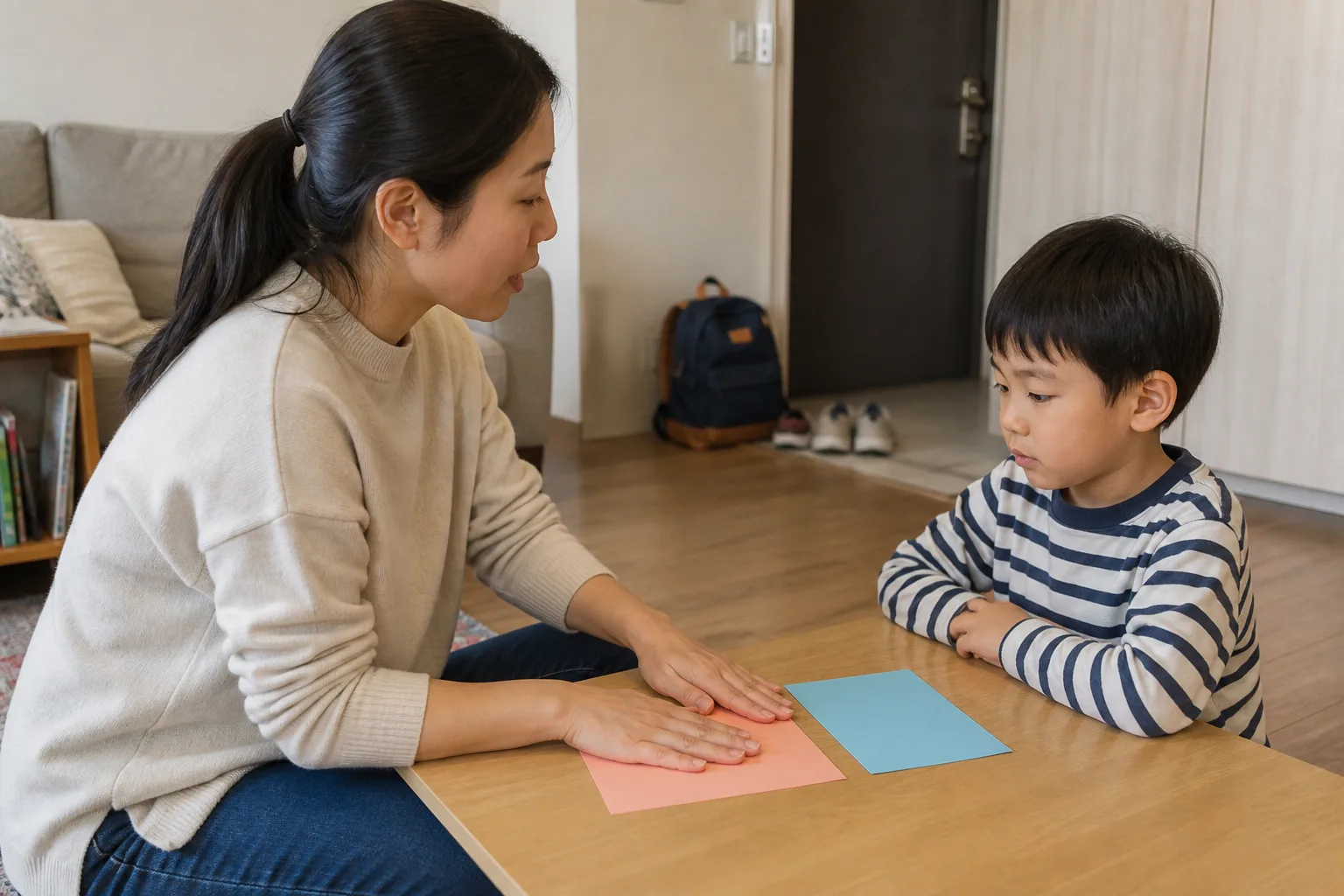
When the backpack stays closed after school, check the first action before arguing about finishing the homework. If your child does not understand the assignment, or if fatigue or learning difficulties keep coming up, look at the conditions with the school instead of relying on reminders.
Key point
Break down the conditions for starting and the first action. Do not treat an ongoing difficulty only as a discipline problem.
What to remember
- Check the assignment, submission method, and needed materials first.
- For the first 10 minutes, it may be enough to check the assignment, take out materials, and read the first problem.
- Tell the teacher and clinician if your child struggles to understand the task or focus, feels anxious, or has trouble seeing. Also describe whether usual activities such as sleeping, eating, or going to school have become difficult.
Turn "Do your homework" into the first action
"Do your homework" contains many steps: opening the backpack, finding the assignment, and finding a pencil. Choose one first action: "Put down the math notebook and read number 1." Starting feels easier when you decide in advance on a time, place, and needed materials. The parent does not write the answers.
Repeated reminders usually point to one of three places
A child who does not know the assignment, one who used all their energy at school, and one avoiding work that feels too hard may look similar. Before reminding again, see whether your child can answer what the assignment is, whether their body looks worn out, and whether they stop only with a particular subject.
The response differs. Check the planner and assignment together when the task is unclear. Put a snack and rest first when the child is exhausted. Break the work down further or ask the teacher when it is too hard. If you are unsure, ask once, "Do you know what you need to do first?" Then wait for the answer.
Use the first 10 minutes to make starting easier
For a large assignment, set a 10-minute timer and choose a small task, such as "write the title" or "read two problems." The 10 minutes are not a standard for attention or a treatment period. Decide whether to continue or rest based on fatigue and the type of work. During a break, drink water and stretch lightly, but do not keep delaying meals and sleep for homework.
Step back after the work begins
Once the first action is clear, the caregiver can step away instead of explaining answers or checking repeatedly. If your child gets stuck, have them call you with the help phrase you agreed on. Watch your child's response to see whether your presence helps them begin or adds pressure.
Do not compare their homework routine with a sibling's. The amount of work, fatigue, and events at school can change what support a child needs to start.
Check the conditions for starting before focusing on the desk
A perfectly quiet room is not always the answer. Keep the assignment, pencil, and water together, and reduce notifications and unrelated screens. Ask once, "What will you do first?" without answering for your child. If the amount or difficulty does not fit, ask the teacher what the assignment is meant to practice.
Prepare words for asking for help
Choose a help phrase together for times when your child says, "I don't understand." It could be, "Can you read the question with me?" or "Can I mark this to ask the teacher?" Use words your child can actually say. On a day the work is unfinished, do not begin with punishment. Note whether the child got stuck on materials, starting, or understanding.
Leave the next starting point, even when the work is unfinished
Even if the homework is not finished, write one line about what belongs in the backpack, what to ask the teacher, and the first action for next time. A parent finishing the work may make that day calmer, but it can hide the point where the child needs to ask for help.
If the work is repeatedly too much or too hard, give the school specific information instead of adding more time at home. Saying where the child stops in which subject makes it easier to plan support than saying, "We fight every day."
An ongoing difficulty may call for evaluation
If paying attention, organizing materials and tasks, reading, writing, or managing anxiety remain difficult at home and school and disrupt daily life, tell the teacher and pediatrician. Also check headaches and eye strain. Homework refusal alone does not diagnose ADHD or a learning disability. Do not change medication based on general advice.
Worksheet
The first 10 minutes of homework
Write down the small first action so your child can see it.
- Assignment
- Task and materials
- First action
- One action to take
- Help
- Words to use when stuck
- Next
- Continue, take a break, or ask someone
Notes
- The first 10 minutes are a tool for starting, not a medical standard.
- A child who goes straight to an after school program or already completed homework in child care does not need this chart. If your child has a way to start independently, preserve that method instead of adding more involvement.
- Tell the teacher and clinician about ongoing learning, attention, vision, or anxiety concerns.
References
- American Academy of Pediatrics: Back to school tips for families
- American Academy of Pediatrics: Developing good homework habits
- American Academy of Pediatrics: ADHD and homework
- CDC: ADHD support in the classroom
This is general guidance for starting homework. It does not replace diagnosis or treatment of a learning disability, ADHD, vision concern, or mental health problem.