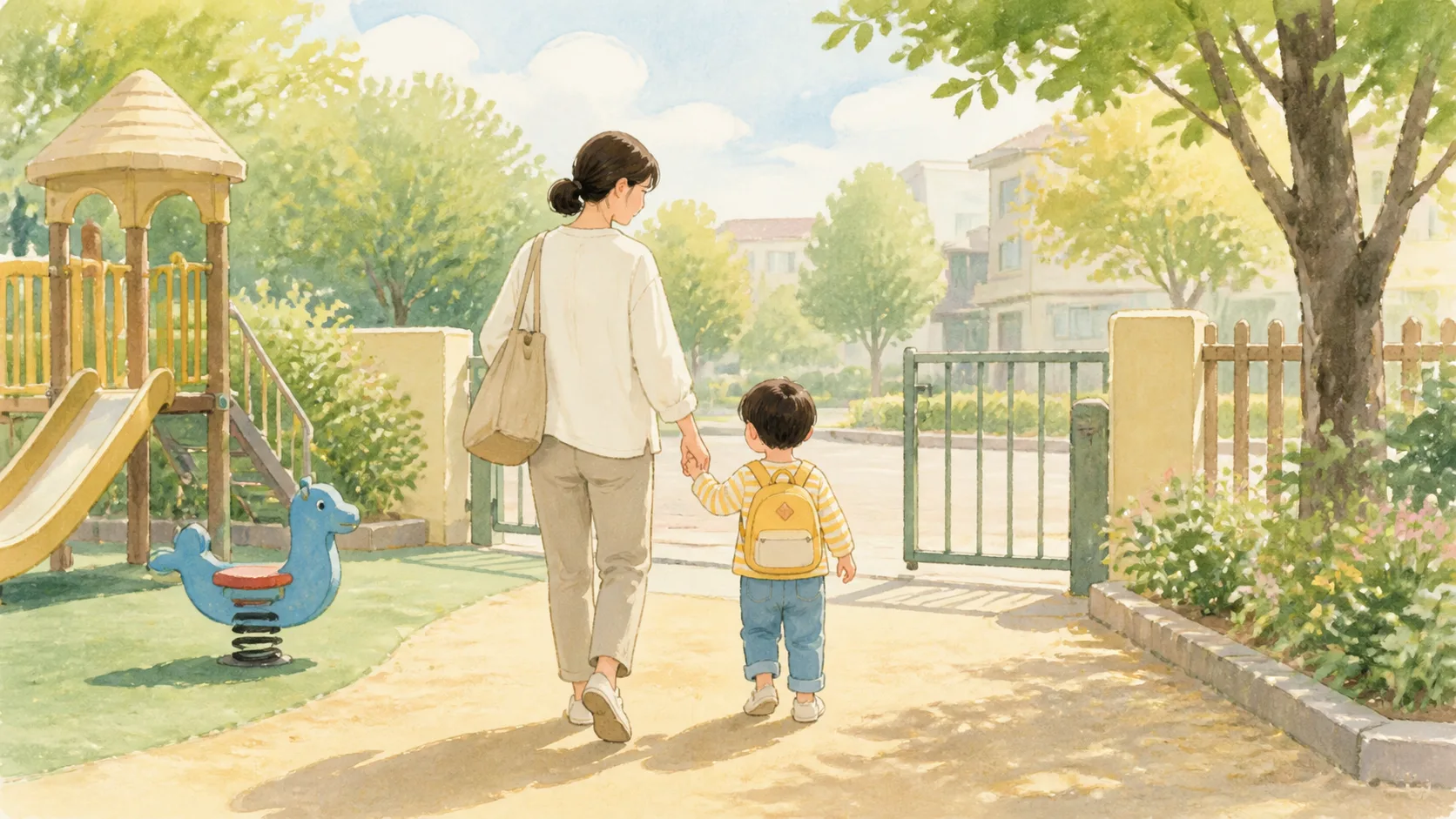
Parents also feel rushed when a child will not get off the swing or runs away from the exit. There is little time for a long discussion when a road or parking lot is close. Prepare three parts separately: a warning before play, a short signal at the end, and immediate protection in a dangerous moment.
Key point
Explain the condition for leaving in advance, choose a visual signal and one last activity, then give only one direction when play ends, such as, "Hold my hand and walk to the exit."
What to remember
- Briefly explain how play will end before it begins.
- After one last activity, name the next place clearly.
- Near roads and parking lots, immediate safety comes before negotiation.
Explain how you will leave when you arrive
Right after reaching the playground, do not use only a vague phrase such as, "We will leave when the sun goes down." Choose one signal the family can notice, such as a phone alarm, sunlight reaching a bench, or snack time. Say briefly, "When we hear this sound, you can go down the slide once more, then we will go to the exit."
Simple and predictable routines are easier for young children to follow. Explain a changed plan while the child is calm. A warning does not promise that your child will leave happily. It tells the child what happens next.
At the end, offer one last activity and one direction
When the alarm sounds, do not ask a broad question such as, "Do you want to play more?" Say, "One more time on the slide, then hold my hand and walk to the exit." Your child can choose the final activity from two options, such as the swing or slide.
After the last activity, do not add a long explanation. Get to the child's eye level, say the child's name, and name one action: "Let's walk to the bag," or, "Hold either my hand or the stroller." A specific direction with one action at a time is easier for a young child to understand.
When a child runs or drops down, safety comes before more words
If your child runs toward a road, parking lot, water, or high playground equipment, do not wait for the child to choose. Move close, safely block the child, and hold a hand or carry the child away from danger. Say briefly, "Cars drive here, so I will take you with me." Do not describe moving the child to safety as punishment or humiliation.
If your child drops down on safe grass or near a bench, remove nearby hazards. Then offer two possible choices: "You do not want to go. Should I carry you to the bag, or shall we hold hands?" Keep the condition for leaving even if the child cries. Use a low voice and short sentences.
If it keeps happening, record the scene instead of trying to fix the child
Note whether leaving is hard at a time when the child is always hungry, on a crowded playground day, or only when a sibling comes along. Next time, you might shorten play, eat a snack first, or choose the last activity near the exit. Warning times and cards do not remove every child's resistance.
If transition difficulties also continue with language, sensory needs, sleep, or child care and keep disrupting family outings, or the child repeatedly runs into danger and is hard to keep safe, describe the current scenes to the child's medical professional or a developmental support service. Do not label the behavior a bad habit or stubbornness.
Create the next scene even on a day you missed the warning
If you forgot the alarm or noticed the time late, do not give a long apology or make several new promises. State the fact and next action: "I did not tell you in advance. We need to go now. Let's go to the exit together." If your child ran toward danger and you carried the child to safety, put the child down in a safe place and briefly reconnect: "I carried you because there were cars. You did not want to leave the playground."
Before the next outing, make only one plan again: "When the alarm sounds, one more swing, then the bag." Do not choose a warning time the caregiver cannot keep. In the record, focus on where the child stopped, which words led to movement, and what increased danger instead of only whether the child cried.
Worksheet
3-step card for leaving the playground
This is a signal the family can repeat, not a minute-by-minute goal.
- When arriving
- Today's ending signal and one last activity
- At the end
- Two choices to offer your child
- Move
- One action to take to the exit
- Safety
- What the parent does right away in a dangerous place
- Record
- Repeated conditions such as hunger, noise, or time
Notes
- Do not threaten to leave a child in a dangerous place or pretend to do so.
- Close adult supervision is always needed near traffic and water.
References
- Centers for Disease Control and Prevention: Making routines and rules predictable
- Centers for Disease Control and Prevention: Steps for giving children good directions
This is general guidance for transitions. It does not replace an individual assessment of traffic safety, development, or behavior concerns.