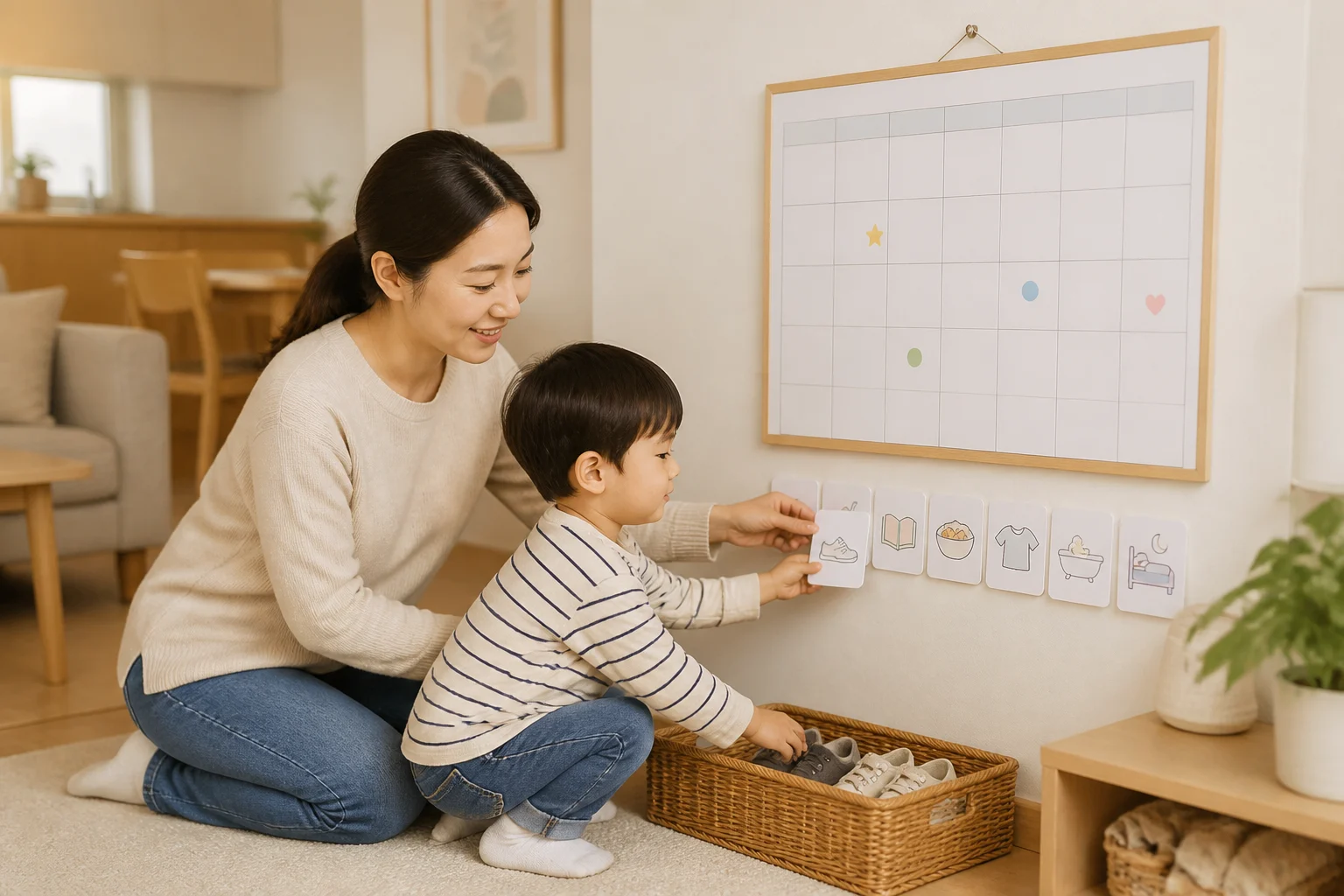
If yesterday's goal was getting ready in the morning, today's is cleanup, and tomorrow's is avoiding outbursts, deciding where to start gets harder. Instead of a broad goal about making the child or parent a better person, choose one repeated daily scene. Narrow it to an action anyone can see, such as "Take shoes out of the basket before going out," instead of "Speak kindly."
Key point
For one scene, choose one action for the child and one way the caregiver will help. Set a date to review it after a few days, but stop or change it that same day if it puts too much strain on the family or creates a safety or health concern.
What to remember
- Write the goal as one visible action in a specific scene, not as a personality trait.
- The caregiver prepares a short, specific direction and then describes the action right after it happens.
- Do not wait for the planned end date if safety, health, sleep, eating, or emotional concerns grow. Seek help.
Choose one everyday action as the goal
Before filling a month-long plan with many goals, choose the one scene that gets stuck most often. Instead of "Do not fight every evening," you might begin with, "Put two toys in the basket before dinner." Write the child's action and the caregiver's support separately. This shows where the parent can adjust even when the child's behavior has not changed.
Choose a time and place to observe instead of expecting perfection every day. An empty check box does not mark failure. It is information that can help you reconsider that day's tiredness, schedule, number of objects, or level of help. When you want to switch goals, first ask whether the task you chose is too demanding instead of adding another chart.
Keep the direction short and close to the action
With a young child, move close, name one specific action at a time, and give the child time to follow it. Instead of "Get ready properly," say, "Let's take your shoes out of the basket." When the child moves, describe what you saw: "You took out your shoes."
Praise is not a stamp that proves the goal was met. On a day your child cannot do it, do not call it a lack of effort or give an even longer explanation. If you are using too many words, reduce the action by one more step or put the needed items nearby first.
Set a date to review it
Write down the starting scene, one action for the child, and one way the parent will help. Then set a date a few days later to review them. No one period works for every family. If the burden grows after 3 days, change the plan right away. If it helps, you can continue.
For a goal of taking out shoes at the entryway, put the basket in a low place and say, "Let's take out one shoe." If this is hard, pull the shoe out halfway or leave only one pair visible. Look at which help actually worked instead of counting how many times the child succeeded.
Stop the goal in these situations
Stop if your child is sick, the family schedule falls apart, or the goal makes sleep, meals, or play harder. Adults must take responsibility for behavior tied to roads, water, medicine, hot objects, and other safety risks. Do not leave it for a child to practice alone. Rules and routines can make life more predictable, but they are never a reason to tolerate danger.
Do not keep shrinking the goal and pushing through if difficulties with understanding speech, movement, sensory needs, sleep, eating, or mood continue across several settings, or if your child loses a skill used before. Record when the concern began and the daily scenes where it appeared, then tell the pediatrician or a related support service.
A review helps choose the next step
On the review day, do not ask only whether it worked. Write down what felt easy, what was too large, and what the adult prepared ahead of time. Even if your child could not take out the shoes alone, pointing at the basket or reaching toward it can help you choose the next kind of support.
When you end the current trial, you do not need to set a new goal right away. You can pause until a less busy week, simplify the same task, or focus for now only on safety, rest, and connection.
Worksheet
One scene to look at this time
Write one action for your child and one way the parent will help, then set a review date.
- One scene
- When and where things get stuck
- Child's action
- One thing you can see
- Adult support
- One short phrase or change to the setting
- Observation
- What was easy, the strain, and the setting
- Stop signs
- Safety, health, or strain on the family
- Review date
- A date you can move earlier if the burden grows
Notes
- The number of check marks is not a score of your child's worth or your parenting ability.
- A one-behavior trial does not treat developmental, sleep, eating, or emotional concerns. Seek a professional evaluation when needed.
References
- Centers for Disease Control and Prevention: Creating structure with routines and rules
- Centers for Disease Control and Prevention: Steps for giving good directions
- Centers for Disease Control and Prevention: Essentials for parenting toddlers and preschoolers
This is general guidance for adjusting goals. It does not replace an evaluation or treatment for developmental, sleep, eating, or mental health concerns.