A first children's museum visit starts with checking that everyone in your family can enter. Confirm each child's age, the number of adults, entry time, and stroller rules. At the museum, start with an activity your child feels comfortable approaching. You can leave early if they get tired.
Key point
Settle the booking requirements and bag storage first. Once inside, alternate between spaces your child chooses and places to rest.
What to remember
- Check who must be included in the booking and how many accompanying adults are required.
- Allow repeated play while respecting other children's turns and the session's end time.
Count your family before choosing tickets
Check how many children and adults to enter, whether visitors admitted free still need a reservation, and whether you need proof of age. If siblings are coming, check the spaces and accompaniment rules that apply to each child.
Some venues set the number of required adults according to the number of infants and toddlers, and require children to be accompanied. Read the guidance for the museum you plan to visit rather than assuming its rules match another museum's.
Think about what you will need after parking the stroller
If everything is loaded onto the stroller, you may need to repack at the exhibit entrance. Some venues require strollers to stay outside exhibition spaces and allow food only in designated rest areas. Before leaving, check whether bag storage and eating areas are separate.
You do not have to join a line as soon as you enter
Move only what you need during the visit, such as diapers and spare clothes, into a small bag. Then find the restrooms and exits. If moving without a stroller is difficult, or your child needs a break from sensory stimulation, ask staff about accessible routes and places to rest. If the arrangements do not work for you, shorten the visit or choose another day.
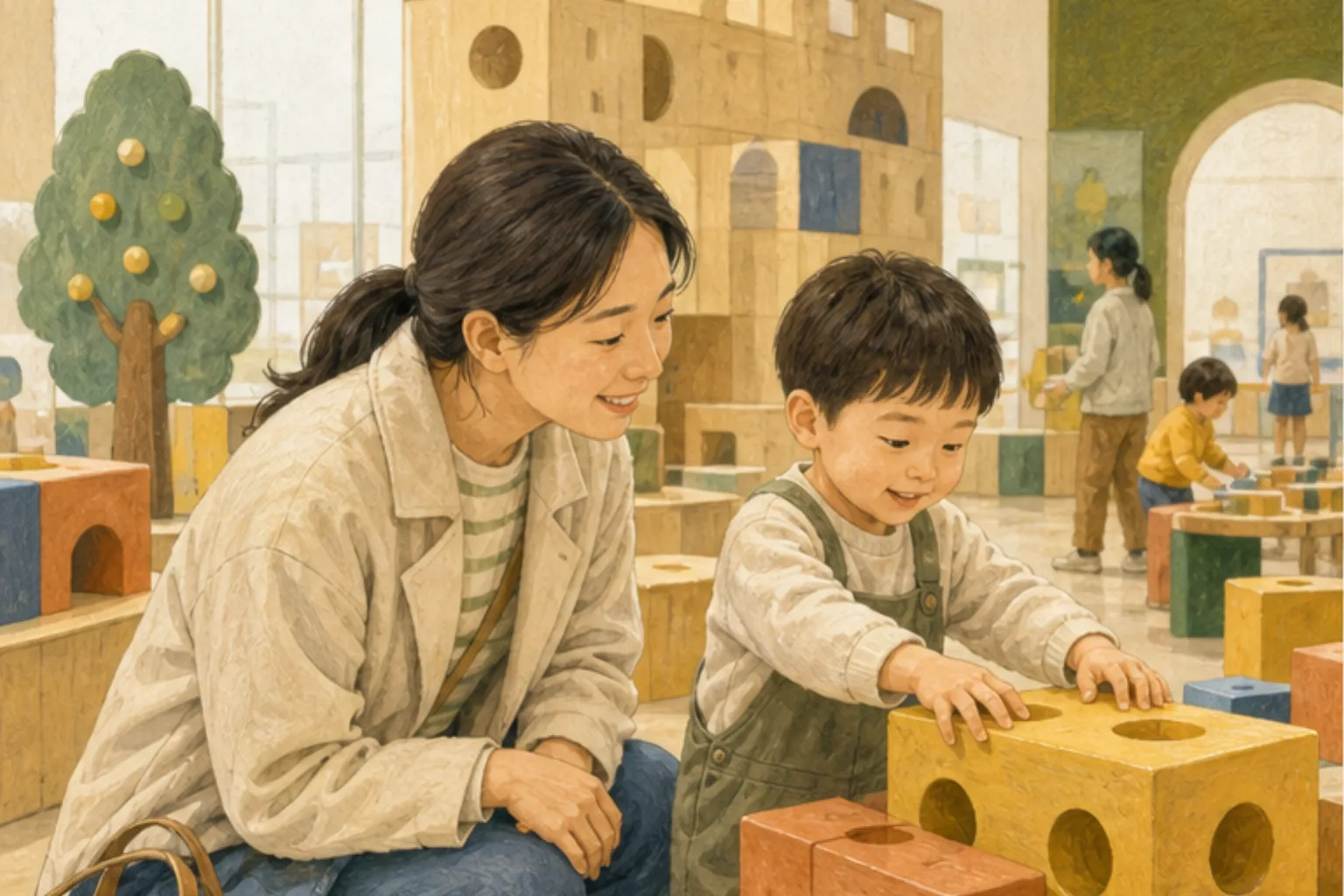
Start where your child pauses to look instead of taking them straight to a popular exhibit. If sounds or lighting feel unfamiliar, watching from a distance is fine. Instead of "Press that button," you could ask, "Shall we watch from here or go a little closer?"
Let your child know when repeated play needs to end
If your child presses the same device several times, you do not need to move them through every exhibit. Watch beside them and describe what you see: "You pressed it slowly this time." Avoid repeatedly interrupting play to ask questions they must answer.
Pass the turn on when another child is waiting or the session ends. Give a heads-up: "Someone is waiting behind us. Let's make room after this turn." If waiting is still difficult, choose another, quieter space.
Work backward from your departure time, allowing for the restroom, collecting bags, and putting on shoes. Then choose the final activity. Offer activities available now instead of promising one with a long line. Afterward, prepare to leave without adding another exhibit. Your child does not have to give a review of the visit if they do not want to.
Worksheet
Plan for entry, breaks, and leaving
Use the booking page and visitor guidance to fill in what you still need to know.
- Getting everyone in
- Each child's age / number of adults / people in the booking / documents to bring / permitted entry time
- Bags and breaks
- Where to leave the stroller and bags / where to eat and rest / staff to ask for help
- Leaving with your child
- When to finish the last activity / time for the restroom and collecting bags / the route to the exit